How to Level Up Pets Fast in Grow a Garden (2026): Best XP Farming Methods
Learn how to level up pets fast in Grow a Garden with XP-boosting pets, feeding tips, treats, and efficient strategies to reach Age 50 and beyond.
In this article
Leveling up pets is an important part of progressing in Grow a Garden on Roblox. As your pets gain experience points (XP) and increase in age, they can become heavier, improve certain abilities, and unlock additional gameplay opportunities.
However, reaching higher pet ages can take time, especially if you're not using the right leveling strategy. Players often wonder how to level up pets fast in Grow a Garden, which pets provide the best XP boosts, and how to reach Age 50 efficiently.
Fortunately, there are several ways to speed up pet progression, including feeding pets regularly, equipping XP-boosting companions, using treats, and optimizing your pet team.
This guide explains how pet leveling works and the most effective methods to gain XP faster.
Quick Answer: The fastest way to level up pets in Grow a Garden is to keep them fed, equip XP-boosting pets such as Capybara, Blood Owl, or Night Owl, and use XP treats when available. Combining compatible bonuses and maintaining an efficient pet setup can significantly reduce the time needed to reach Age 50.
How Does Pet Leveling Work in Grow a Garden?
In Grow a Garden, pets gain experience points over time and increase their Age as they accumulate enough XP.
Unlike traditional RPG games, where characters gain levels primarily through combat or quests, Grow a Garden pets progress through a combination of passive XP gain and applicable support effects.
Understanding how this system works is essential before trying to speed it up.
How Pets Gain XP and Increase Their Age
Pets typically begin at Age 1 after hatching.
When equipped and able to gain XP, they gradually accumulate experience toward the next age.
As a pet becomes older, several characteristics may change:
- Pet Age: Increases as the pet accumulates experience.
- Pet Weight: Generally increases as the pet ages.
- Pet Abilities: Certain abilities may become more effective as pets develop.
- Ability Cooldowns: Some pets experience shorter cooldowns as their age increases.
However, the amount of XP required increases at higher ages.
For example, progressing from Age 1 to Age 10 requires significantly less experience than progressing from Age 40 to Age 50.
This is why pets often appear to level up quickly at first but slow down as they become older.
What Affects Pet XP Gain?
Several factors can influence how quickly your pets gain experience.
| Factor | Effect on Pet Leveling |
|---|---|
| Hunger | Ordinary pets generally stop gaining XP when hunger reaches zero |
| Pet Weight | Can influence the pet's base XP rate |
| XP-Boosting Pets | Provide additional experience to eligible pets |
| Pet Treats | Temporarily increase XP gain |
| Pet Mutations | Certain mutations provide XP-related bonuses |
| Team Setup | Determines which support abilities affect the target pet |
Combining these factors effectively can make a substantial difference in leveling speed.
Pet Age vs Pet Weight: What's the Difference?
Pet Age and Pet Weight are related, but they represent different characteristics.
Pet Age reflects the pet's progression through experience points.
Pet Weight represents its size and can influence certain abilities and trading calculations.
As pets grow older, their weight generally increases according to their original hatch weight and the game's progression mechanics.
However, two pets of the same age may have different weights because they hatched at different sizes.
You can use theGrow a Garden Pet Age Calculator to understand age milestones and estimate the experience needed to reach your target.
How to Level Up Pets Fast in Grow a Garden – 6 Effective Methods
If your goal is to reach Age 50 or level up multiple pets efficiently, the following methods can help you improve your XP farming strategy.
Method 1 – Keep Your Pets Fed
One of the simplest ways to improve pet leveling is to maintain your pets' hunger levels.
In Grow a Garden, most pets need food to continue gaining experience normally.
When a pet's hunger reaches zero, its normal XP progression stops.
To feed your pets:
- Harvest crops from your garden.
- Hold a harvested crop.
- Approach the pet you want to feed or open its pet menu.
- Select the feeding option.
- Check the hunger bar to confirm that it has increased.
Different crops restore different amounts of hunger.
Larger or more substantial fruits can be convenient because they may restore more hunger per feeding.
For example, Watermelon, Pumpkin, and other high-value crops can be useful when maintaining several pets.
Important: Feeding a pet primarily maintains the conditions needed for XP progression. It does not automatically mean every crop grants an immediate XP reward.
Before starting a long leveling session, check that your target pet has enough food.
Method 2 – Equip Pets That Boost XP
Some pets have special abilities that increase the experience earned by other pets.
These companions are commonly called XP helpers.
Instead of relying only on a target pet's normal XP gain, you can equip support pets that provide additional experience.
Popular XP-supporting pets include:
- Capybara: Supports nearby pets with XP-related benefits and hunger management.
- Blood Owl: Provides additional experience to active pets.
- Night Owl: Helps other active pets gain experience faster.
- Sea Turtle: Can grant bonus experience to another pet through its ability.
For example, if you're leveling a valuable pet, equipping an XP helper alongside it can increase its effective XP gain.
Some helpers work across your active team, while others require pets to remain within a specific range.
Therefore, it's important to understand each helper's ability before choosing your team.
Method 3 – Use Pet Treats and XP Boosts
Pet Treats are another useful way to accelerate leveling.
Certain treats provide temporary experience bonuses to the pet receiving them.
Examples include:
Small Treat: Provides a smaller XP boost over a limited duration.
Medium Treat: Provides a stronger XP boost over time.
These items may be available through supported Gear Shop rotations, crafting systems, or other game features, depending on the current update.
To use an XP Treat:
- Obtain an eligible treat.
- Equip or select the treat.
- Choose the pet you want to level.
- Apply the treat to that pet.
- Monitor its XP progression while the effect is active.
Treats are particularly useful when combined with XP helper pets.
For example, using an XP Treat on a pet supported by Blood Owl may increase its leveling efficiency compared with relying on its base XP rate alone.
However, different boosts may use different stacking rules.
Tip: Don't confuse Pet Treats with Pet Toys. Treats are intended to support XP gain, while Toys generally improve pet passive abilities.
Method 4 – Build an XP-Focused Pet Team
A good XP farming team is built around one simple objective: helping your target pet gain experience efficiently.
Instead of equipping random pets, divide your active pet slots into two roles.
Target Pet: The pet you want to level up.
Support Pets: Companions that provide XP boosts, hunger-related benefits, or other useful effects.
For example, a simple leveling team might include:
- 1 target pet.
- 1 Capybara.
- 1 Night Owl.
This setup combines a pet that needs experience with companions that can help it progress faster.
Players with additional pet slots may expand the team using other compatible XP helpers.
Keep in mind that the optimal combination depends on available slots, support abilities, pet statistics, and the current stacking rules.
Method 5 – Take Advantage of Passive XP
Many pets gain experience passively when the required gameplay conditions are met.
This means you don't necessarily need to perform a separate action every time a pet receives XP.
The key is to maintain the conditions that allow passive experience to continue.
For example:
- Keep the target pet equipped.
- Maintain its hunger above zero.
- Equip compatible XP-supporting pets.
- Keep pets within any required support range.
- Check whether temporary bonuses remain active.
Some pets also have special self-leveling abilities.
Starfish, for example, is known for generating additional XP for itself.
However, Starfish's self-XP ability should not be confused with an aura that increases experience for every other pet.
Understanding this distinction helps prevent inefficient team setups.
Method 6 – Optimize Your AFK Leveling Setup
AFK leveling is a strategy where players organize their pets to gain experience with minimal direct interaction.
For longer leveling sessions, an effective setup usually focuses on XP generation and hunger management.
Capybara is particularly useful because its ability can support nearby pets while helping address hunger-related interruptions.
A basic AFK-oriented setup involves:
- Equipping the pet you want to level.
- Adding compatible XP helpers.
- Placing or maintaining pets within the required support area.
- Checking hunger levels before the session.
- Monitoring XP periodically to ensure progression continues.
Be aware that AFK leveling and offline progression are not necessarily the same.
XP gain may depend on whether the pet is equipped, game mechanics are active, or the server continues processing the relevant effects.
Avoid assuming that leaving the game entirely will produce the same results as staying in an active session.
Best Pets for Fast XP and Leveling in Grow a Garden
Choosing the right XP-supporting pets can make a major difference when training valuable companions.
Some pets increase XP for others, while certain pets specialize in gaining experience themselves.
The following table highlights several useful options.
| Pet | XP-Related Ability | Best Use |
|---|---|---|
| Capybara | Provides XP support and hunger-related benefits to nearby pets | AFK and team leveling |
| Blood Owl | Increases XP gained by eligible active pets | General XP farming |
| Night Owl | Supports experience gain for active pets | Team leveling |
| Sea Turtle | Periodically grants bonus XP to another pet | Additional XP support |
| Starfish | Generates extra XP for itself | Self-leveling |
Exact XP bonuses, ability ranges, and stacking behavior may vary with pet statistics and game updates.
Capybara – A Strong Choice for XP Farming
Capybara is especially useful for players who want to level several pets efficiently.
Its supportive ability can provide additional XP to pets within its range while helping manage hunger.
This combination makes it valuable for extended leveling sessions.
However, positioning matters.
A pet outside the supported area may not receive the same benefits.
Players planning a long-term XP farming setup should consider theCapybara Pet Details to better understand its characteristics.
Blood Owl and Night Owl – Team XP Support
Blood Owl and Night Owl are useful choices for players who want to increase experience gain across their active pet team.
These pets are particularly valuable when you're leveling a companion that doesn't provide its own XP boost.
Their main advantage is that they can contribute experience-related benefits without requiring you to repeatedly perform a separate farming action.
You can explore their individual information through theBlood Owl Pet Guide andNight Owl Pet Guide.
Which XP Pet Should Beginners Use?
For beginners, the best XP helper is usually one they can realistically obtain and use.
You don't need a collection of expensive pets to begin improving your leveling speed.
If you already own an Owl-type XP helper, start by equipping it alongside the pet you're training.
Capybara is another useful target because it combines XP support with hunger-related benefits.
Players who don't own any XP-supporting companions should prioritize feeding their existing pets and gradually building a better collection.
How to Build the Best Pet XP Farming Setup
An effective pet leveling setup should balance XP support, hunger management, and available pet slots.
The best arrangement depends on whether you're just starting or already have several specialized companions.
Beginner XP Farming Setup
If you have only a few active pet slots, focus on one pet at a time.
An example setup is:
| Slot | Pet | Purpose |
|---|---|---|
| 1 | Target Pet | Receives XP |
| 2 | Night Owl or Blood Owl | XP support |
| 3 | Capybara | XP and hunger support |
This setup is intended as an example, not a requirement to own all three pets.
If you only have one helper, use it alongside your target pet and maintain hunger manually.
Prioritizing a small number of compatible pets is generally more effective than filling limited slots with companions whose abilities don't contribute to leveling.
Advanced XP Farming Setup
More experienced players may use several compatible XP helpers to improve their overall experience gain.
An advanced setup could include:
- One valuable pet that needs leveling.
- One or more Capybaras.
- Blood Owl or Night Owl.
- Additional compatible XP helpers.
The goal is to increase the target pet's XP gain while keeping its hunger from interrupting progress.
However, additional helpers are only worthwhile if their abilities apply to the target and their benefits follow compatible stacking rules.
Position Your Pets for Maximum XP
Not every XP helper has the same effective range.
Some support pets apply bonuses to active companions, while others rely on nearby positioning.
For example, a Capybara's support area matters because a target pet must remain within the applicable range to benefit from its ability.
When building your setup, check:
- Whether the helper affects all active pets or only nearby ones.
- Whether the target pet qualifies for the ability.
- Whether multiple copies of the helper can provide additional benefits.
- Whether the effect remains active during your intended leveling session.
Correct positioning can be just as important as owning the right pets.
How to Reach Age 50 Faster in Grow a Garden
Age 50 is an important progression milestone in Grow a Garden.
Players often aim for this age because it is associated with the Pet Mutation Machine.
Reaching the milestone efficiently requires a combination of consistent XP gain, useful helpers, and proper hunger management.
Why Is Age 50 Important?
The standard Pet Mutation Machine requires an eligible pet to reach at least Age 50.
The machine allows players to obtain a pet mutation, which may change the pet's appearance or provide additional benefits.
Some mutations can also influence XP generation or other pet statistics.
However, the mutation process can reset the pet's age, so players should consider whether they want to continue leveling before using the machine.
For details about the process, visit theGrow a Garden Pet Mutation Machine Guide.
Best Strategy to Level Pets From Age 1 to 50
If your main objective is reaching Age 50, follow this approach:
- Choose one target pet: Focus your resources on the companion you want to level.
- Maintain Hunger: Keep its food level above zero.
- Equip XP Helpers: Use Capybara, Blood Owl, or other available support pets.
- Apply XP Treats: Use suitable boosts when available.
- Optimize Your Team: Remove pets that don't contribute to your leveling goal.
- Monitor Progress: Track how much XP is still needed.
As your pet reaches higher ages, the remaining XP requirement becomes increasingly important.
This is when maintaining consistent XP gain can be more beneficial than frequently switching between different target pets.
How to Keep Leveling Beyond Age 50
Reaching Age 50 doesn't necessarily mean your pet has reached its maximum potential.
Pets can continue gaining XP and increasing in age beyond this milestone.
Higher ages may provide additional benefits, including weight growth and improvements to certain abilities.
However, the experience requirement continues to increase.
For players interested in long-term pet development, it's worth comparing the benefits of additional leveling against the time required.
How to Calculate Pet XP and Leveling Time
If you're trying to level a pet efficiently, knowing approximately how much experience it needs can help you plan your strategy.
Grow a Garden's pet progression follows an increasing XP curve, meaning later ages require more experience than earlier ones.
Understanding XP Requirements by Pet Age
The website's Pet Age reference currently provides the following approximate cumulative XP milestones:
| Target Age | Approximate Cumulative XP |
|---|---|
| Age 10 | 2,100 XP |
| Age 25 | 13,300 XP |
| Age 50 | 54,000 XP |
| Age 100 | 219,000 XP |
These are rounded planning figures based on the website's reference data, not guaranteed exact in-game requirements. Recheck the calculator when game formulas change.
The difference between these milestones shows why high-level pets require much more training.
A pet that reaches Age 10 quickly may still need considerably more time to reach Age 50 or Age 100.
Estimate Leveling Time With the Pet XP Calculator
Instead of estimating everything manually, you can use theGrow a Garden Pet XP Calculator.
The tool is designed to help estimate how long it may take a pet to reach a particular age.
To use it:
- Select the pet you want to level.
- Enter its current weight.
- Set its current age.
- Choose your target age.
- Select any supported XP-related mutation.
- Add Capybara helpers and their statistics if applicable.
- Review the estimated XP requirement and leveling time.
For example, if your pet is currently Age 20 and you want it to reach Age 50, the calculator can estimate the experience still required.
You can then adjust the helper setup to understand how additional XP support might affect the result.
This makes it easier to decide whether investing in another XP helper is worthwhile.
Example – How Much Can XP Boosts Reduce Leveling Time?
Consider a simplified example where a pet needs 54,000 XP to reach its target age.
Without any additional support, assume it earns an average of 10 XP per second.
With XP helpers, suppose its effective average increases to 20 XP per second.
| Scenario | Average XP Rate | Estimated Time |
|---|---|---|
| Without XP Helpers | 10 XP/sec | 90 minutes |
| With XP Helpers | 20 XP/sec | 45 minutes |
In this hypothetical example, doubling the average XP rate cuts the required time in half.
However, actual gameplay is more complex because a pet's weight, XP rate, hunger, bonuses, and other characteristics may change during progression.
Therefore, this example explains the relationship between XP rate and leveling time rather than predicting an exact result for a particular pet.
For a personalized estimate, use the Pet XP Calculator and enter your actual pet statistics.
Common Mistakes That Slow Down Pet Leveling
Even experienced players can lose valuable leveling time by overlooking basic mechanics.
Here are several common mistakes to avoid.
Letting Your Pet's Hunger Reach Zero
Most pets cannot continue gaining XP normally when their hunger reaches zero.
Solution: Check hunger regularly and feed your pets before starting long leveling sessions.
Not Equipping XP-Boosting Pets
Relying entirely on a target pet's base XP gain can make progression slower than necessary.
Solution: Equip compatible XP helpers whenever you have available pet slots.
Ignoring XP Helper Range
Some pet abilities only affect companions within a certain distance.
Solution: Check the helper's ability description and make sure your target pet remains within its supported range.
Using Pet Slots Inefficiently
Equipping unrelated farming pets may reduce the space available for useful XP helpers.
Solution: Build a dedicated leveling team when XP farming is your main objective.
Assuming Every XP Boost Stacks
Not all bonuses necessarily combine in the same way.
Solution: Check individual ability descriptions and compare your XP rate before and after changing the team.
Confusing Pet Leveling With Egg Hatching
Egg hatching and pet leveling are separate systems.
Hatching bonuses reduce the time needed to obtain a pet from an egg, while XP bonuses help an existing pet increase its age.
Solution: Use egg-hatching helpers when collecting new pets and XP helpers when training pets you've already obtained.
Frequently Asked Questions About Pet Leveling
What is the fastest way to level up pets in Grow a Garden?
Keep pets fed, equip XP helpers like Capybara and Blood Owl, and use XP Treats to increase experience gain.
How do pets gain XP in Grow a Garden?
Pets gain XP over time through normal progression and can receive additional experience from compatible helper abilities.
Which pet gives the most XP in Grow a Garden?
Capybara is a strong team XP helper, while Blood Owl and Night Owl also provide useful XP support.
Can pets gain XP without food?
Most pets stop gaining normal XP when hunger reaches zero, although certain pets have special XP-related abilities.
Can you level up pets while AFK?
Yes, passive XP can support AFK leveling when the necessary conditions are met. Offline progression may behave differently.
How do you get pets to Age 50 fast?
Maintain hunger, combine compatible XP helpers, use available XP boosts, and track progress with a Pet XP Calculator.
Does pet weight affect XP gain?
Yes. Pet weight can influence base XP gain, while certain helper bonuses and mutations also affect leveling speed.
Conclusion – Level Up Your Pets More Efficiently
Learning how to level up pets fast in Grow a Garden comes down to understanding XP mechanics and choosing an effective training setup.
Keeping your pets fed, equipping suitable XP helpers, using temporary boosts, and optimizing active pet slots can help reduce unnecessary leveling time.
For players working toward Age 50, combining consistent XP gain with a focused team is a practical strategy.
Remember that every pet has different characteristics, so the fastest setup may vary depending on your available helpers and resources.
Before starting your next leveling session, try theGrow a Garden Pet XP Calculator to estimate the XP and time needed to reach your target age.
Related reading
How to Get Pets in Grow a Garden (2026) – Complete Guide
How to Get Pets in Grow a Garden (2026) – Complete Guide
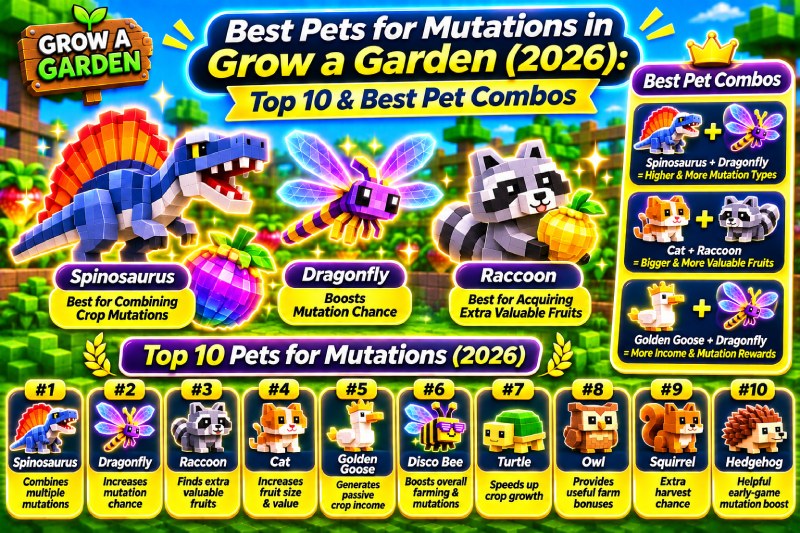
Best Pets for Mutations in Grow a Garden (2026): Top 10 & Best Pet Combos
Discover the best pets for mutations in Grow a Garden. Compare Disco Bee, Space Squirrel, T-Rex and more, plus mutation multipliers and pet combos.
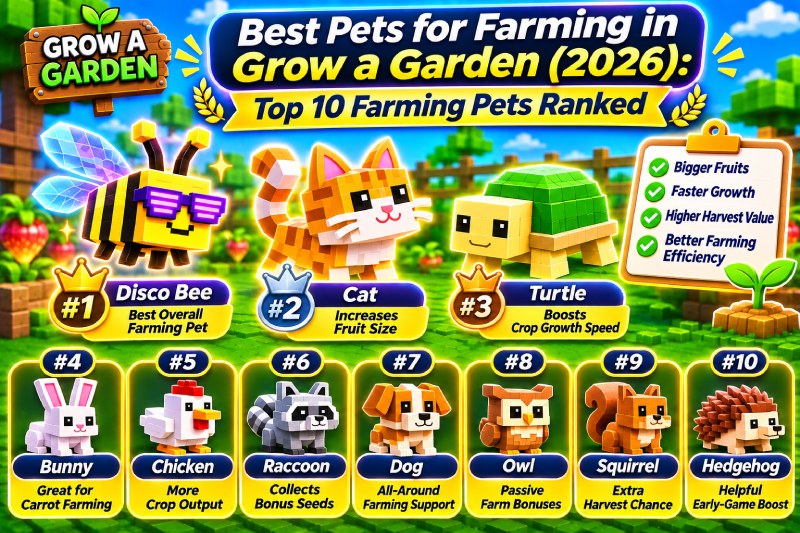
Best Pets for Farming in Grow a Garden (2026) – Top 10 Ranked
Discover the best pets for farming in Grow a Garden. Compare top pets for mutations, crop growth, Sheckles, and efficient farming strategies.